At St. Hockeysticks School for Aggressive Young Women, Arts subjects are terribly underfunded and their problems largely ignored by management. The department heads meet to discuss what can be done about this unjust state of affairs.
Art: The arts in this school are terribly underfunded!
Music: I agree, it’s a shocking state of affairs.
Theatre: We must do something about it.
Music: The orchestra needs more instruments! I think we should campaign for more instruments.
Art: Well, yes, that is a problem, but also my classes have been trying to get by on the same tube of Titanium White all term.
Theatre: And there may not be a school play at all this year unless the bake sale next week is a major hit.
Right. Elliot Rodger and the Isla Vista shootings. Within hours of the story breaking, a number of friends and readers got in touch asking if I was going to write a reaction piece. After five minutes on my newsfeed and on Twitter, I was overwhelmed by exhaustion. That was my dominant emotion. Not anger, not frustration, not sorrow. Just numbing here-we-go-again exhaustion. After half an hour, I did not want to write about this. And watching the conversations pick up speed and the comments roll in – the justifications, the derails, the rationalizations, the outright defenses – made it all feel even more hopeless.
But then I spoke to my sister, who reminded me why it’s important to keep writing and that even if it feels repetitive, these things can’t be said too many times. So thanks, Lars. Also, many of these points are hers or riffing on hers.
And now, in no particular order, my thoughts:
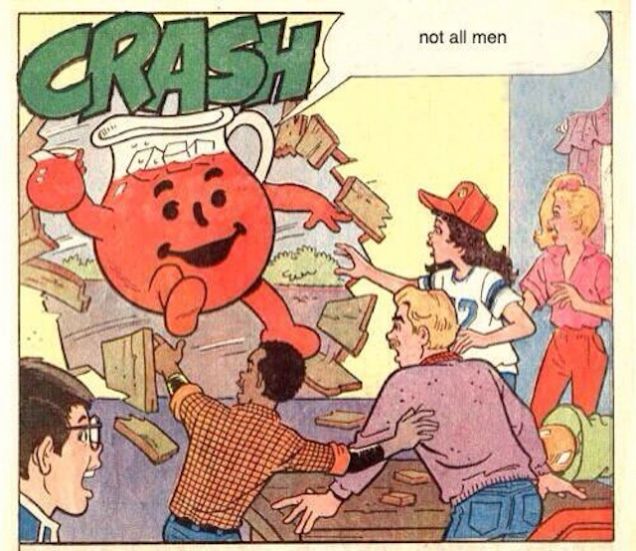
1. There exists a sub-section of men who literally cannot sit through a discussion of structural misogyny without receiving constant and emphatic reassurance that no one is accusing them personally of being a misogynist. This is a derail and an attempt to shut down debate. Because, to quote Sometimes, it’s just a cigar:
“Suppose you disagree with women about whether rape is part of the structure of our society, used to reinforce patriarchy. Do you make that debate possible by standing on your wounded pride, and just insisting that the debate must start with a disclaimer that says you’re not a rapist? Forgive me, but that’s nothing more than narcissism.”
The conviction that you have never participated or been complicit in structural misogyny is dubious to say the least, no matter what your gender. But even if you are resolute that you, personally, have managed to transcend the system you were born and raised in and now stand as a shining beacon of gender equity outside the mire of patriarchy? Good for you, but structural misogyny still exists and we still need to have a conversation about it. If you think you have nothing to learn, go play elsewhere on the internet.
The King of the Ice Zombies also has a lot of opinions about historical accuracy in fantasy.
OK, Internet. New Game of Thrones just started, and I know we’re all very excited.[1] Before the deluge of internet commentary really begins, I think this is an appropriate moment to have a chat about the relationship between fiction and history, and more specifically the relationship between the fantasy genre and the specific periods of Euro-centric history from which it tends to borrow heavily. And specifically, to answer the question: what do we mean by historical accuracy?
It’s a tale as old as the Internet. Someone writes an article about a book/film/game/ interpretative shadow-puppet musical from the fantasy genre. Some members of the audience say, “Hey, I really like this thing, but I would like it more if the women were not being sexually assaulted quite so constantly and the brown people were not costumed entirely in Generic Tribal Chic.” Then, without fail, a deeply indignant nerd type will pop his head over the parapet of the comment box and let forth his ancient war cry: “BUT HISTOOOOOOORY THEREFORE YOUR ARGUMENT IS INVAAAAAALID!!!”
It may seem like I’m overstating for effect here, but this exact exchange just happened on a recent post from Media Diversified. Shane Thomas made some excellent (and, at this stage, well-worn) points about Game of Thrones and its race problems. This attracted the attention of one intrepid commenter, who didn’t bother to read the whole post but nonetheless left a long comment – equal parts condescending and clueless – which boiled down to, “The Mongols existed at some point, therefore Game of Thrones can’t be racist.” In his response, Thomas acknowledges that he is aware that history is indeed a thing, but the fact that history is extremely racist does not give a modern TV show set in a fictional world a free pass to also be racist.
Twitch Plays Pokémon was basically the logical conclusion of the Internet. source: kotaku
Hi everyone! The fields of the link farm have lain fallow for a while, but they shall be all the more fertile for it and a new crop of feminism shall grow strong and abundant in the furrows of this newly-ploughed metaphor.
That is to say, the draft email where I keep interesting links (Iol, what are bookmarks) has become nothing short of unwieldy, so here’s a bumper crop of stuff I read recently (or not so recently) that I found thought-provoking. All of it is articles. In no particular order:
The Twitching of Democracy Could Twitch Plays Pokémon hold the answer to reinvigorating our broken systems of democracy? I have no idea, but fortunately my friend Tadhg decided to grapple with that very question in his latest blog post.
Rage Doesn’t Exist in a Vacuum Women in general, and feminists in particular, are often accused of overreacting or being excessively angry in response to relatively innocuous things. Kameron Hurley does a great job of explaining that a) seemingly isolated incidents are often “blown out of proportion” precisely because they are not isolated incidents and b) anger is actually a necessary tool for changing the status quo.
Should “potential fathers” have any say in abortion? A thorny issue, but this is why I love reading Aoife O’Riordan on reproductive rights; she brings a level on incisiveness and clarity that I would never arrive at on my own and her conclusions always center the needs of the pregnant person above all else. And as a fellow native of a country where abortion is illegal except in the most extenuating of circumstances, her insight is valuable to me on a personal and political level.
Bi-Erasure and The Diary of a Young Girl Anne Frank may not have identified as bisexual, but the fact that her diary was originally scrubbed of homoerotic material prior to publishing is symptomatic of a society that is still profoundly uncomfortable with fluid sexuality. Solomon Wong illustrates how this relates to modern bi-erasure and why young bi people need more mainstream narratives that acknowledge their existence.
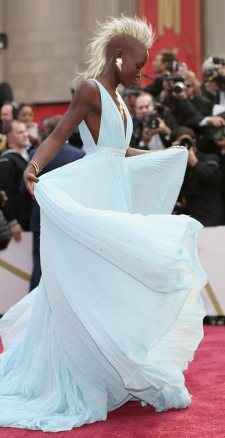
Lupita Nyong’o as mohawked Storm is the best fancast ever. source: Geek Outsider
Bros before Rogues Nicholas DiSabatino asks if the X-Men franchise – despite reams of excellent source material – is getting steadily worse at portraying women as well-rounded characters… or indeed, portraying them at all. (Hint: Yes.)
Why Marketers Fear The Female GeekDisruptive innovation is one of my favourite marketing concepts. It basically means ripping up the rule book and throwing all the data out the window in order to capture (or recapture) a brand new market through bold and original strategies. And this, argues Anjin Anhut, is exactly what videogame companies need to do if they want access to the wallets of the fifty percent of the population they’ve been systematically alienating for the past few decades.
The Night I Kissed A Rapist In this simple personal account, Jan DeVry explores her firsthand experience of discovering that a rapist can be a well-liked, charismatic man with whom you have strong chemistry.
Seeming Female: Gender in Digital Space So at this point we all know that Fake Geek Girl is largely a myth, the fever dream of an adult nerd with a subconscious desire to punish all women for that one time a hot girl ignored him at summer camp. But the always excellent Foz Meadows posits an interesting theory: what if she does exist? What if she exists and what if she is a literal invention of male gamers? “What if the respective myths of the Fake Geek Girl and Fake Gamer Girl are actively being perpetuated, not through the whore-user predations of evil ladies, but because a cynical, sexist subset of male geeks are using stereotypical, strawman portrayals of women to manipulate their peers?” It sounds far-fetched, but the numbers add up and the performance of gender in digital spaces is a strange and elusive beast.
Feminist propaganda Lego advertisement from the 1970s
James Delingpole recently wrote an article called “Why it’s not sexist to say boys should never play with dolls“. I have to ask: is it just me, or are the James Delingpoles of this world getting more and more frantic in their efforts to shove gender roles back into neat little boxes marked Male and Female?
Because to me, interrupting a group of young women during a discussion of their career plans to ask them if they want to settle down and raise a family… that sounds like the behaviour of a floundering man. Delingpole admits that he did this deliberately in part to undermine their “zappy” headmistress, and then brags about in his article as though he’s scored a point for… well, for who or what exactly is unclear. Whatever Delingpole was trying to achieve by recounting this anecdote, he succeeds admirably in coming across as smug, clueless, priggish and thoroughly out of his depth when confronted by a room of bright young women who expect to enter the world as equals to men.
“Does this make me sound like a complete sexist pig?” asks Delingpole, as though a modicum of self-awareness might make it not so.
Frozen fan manip. source: I could not find out who made this. Let me know if you know
Redundant spoiler alert: ALL THE SPOILERS.
Prior to the release of Disney’s Frozen, I highlighted the fact that it was getting some pretty bad pre-release press from fellow feminist pop culture bloggers. The Feminist Fangirl wrote a post about how the original female-centric epic-quest fairytale appeared to have been gutted in favour of yet more bland princess fare. Then, the lead animator put his foot in it by making some poorly thought-out comments about how it’s really difficult to animate female characters, because they have to show emotion but they also have to be pretty, so sometimes they just end up all looking the same. Nightmare, am I right?
When Frozen was released, I deliberately resisted reading any reviews until I’d seen it for myself, although the general background buzz on the feminist blogosphere indicated that it was a lot better than expected. And having eventually seen it, I have to agree. Frozen is a feminist movie.
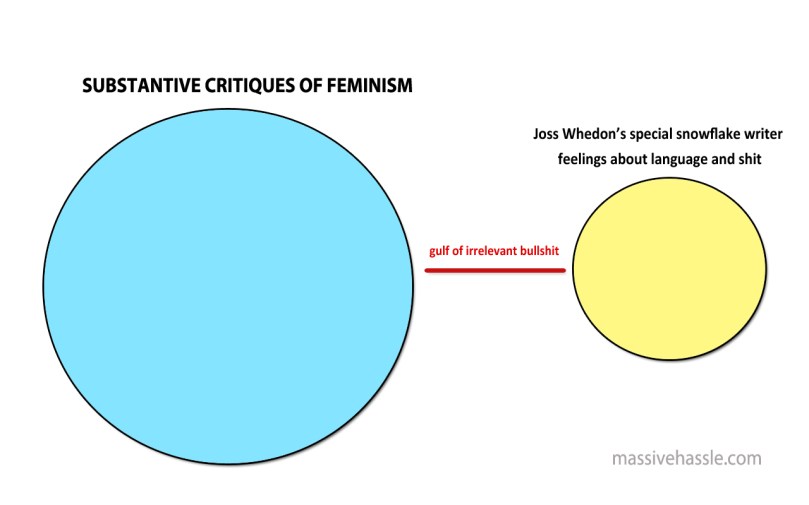
Joss Whedon spoke about feminism at a benefit event for an organisation called Equality Now. More accurately, Joss Whedon spoke about the word “feminist”, because this incoherent self-satisfied trainwreck of a speech completely and utterly failed to engage with the substance of feminism for most of its fourteen minute duration.
Quite a few people sent me this video. Most of them were like, “Look! Yay! A famous nerdy dude said some stuff about feminism!” Sorry friends, but that literally could not have been further from my reaction. Jezebel called it perfect (lol and also facepalm). Lots of feminist organisations I follow on Facebook posted it with approving commentary. (Including The Y Factor, who appear to have deleted it since I left a mild comment suggesting it was a crock of shit. Bad form, Y Factor. If you thought it was good, own it and explain why.)
It’s possible that I would have been more on board with Whedon’s speech if I could actually follow it. He starts off describing – in indulgent syllable-by-syllable detail – how “feminist” as a word just does not do it for him personally. Then he changes track and for a while seems to be equating the word “feminist” to the word “racist”, even though those words have nothing in common besides the dreaded “-ist” at the end. After that, he abandons “feminist” altogether and suggests that we need an equivalent word to “racist” for when we’re talking about gender discrimination. Those words already exist, I hear you cry? Sexist? Misogynist? Nah, those words don’t do it for Whedon either because some people are resistant to them, but mainly because he’s too busy trying to introduce his new word which he came up with ALL BY HIMSELF, GUYS. Guess what it is? Wait until you hear this genius stroke! Genderist! People who discriminate based on gender can be called “genderist”! Inspired! And this will achieve… what exactly? I have no clue, and neither does Whedon by the sounds of things, but he really wants everyone to start using it right away.
This post is long, so if you’d prefer, you can just look at the accompanying diagram, which is probably the most succinct transmission of my thoughts on any subject ever to date. But if you want more, there is more.






 massive hassle