world war disappointed

World War Z: An Oral History of the Zombie War is one of my favourite books ever. I have read it three times and it scared the crap out of me. Good job, World War Z. Unfortunately, Hollywood got its hands on it and stripped it of everything that made it unique and terrifying and profoundly human, because why have any of those things, when you can give Brad Pitt a gun and a vague UN job and throw him up against a big writhing pile of CGI zombies? Don’t worry though, we’re supposed to give a shit about his character because he has a Generic Family with two adorable little girls and he says things like “It’s going to be okay, honey!” and “Tell them I’m coming back!” a lot.

I am not exaggerating:

so the topic of why fast zombies are stupid – both in terms of plausibility and symbolic efficacy – has been well covered. No one puts it better than Simon Pegg:

I know it is absurd to debate the rules of a reality that does not exist, but this genuinely irks me. You cannot kill a vampire with an MDF stake; werewolves can’t fly; zombies do not run. […]The speedy zombie seems implausible to me, even within the fantastic realm it inhabits. A biological agent, I’ll buy. Some sort of super-virus? Sure, why not. But death? Death is a disability, not a superpower. It’s hard to run with a cold, let alone the most debilitating malady of them all.

More significantly, the fast zombie is bereft of poetic subtlety.[…] [T]he zombie trumps all by personifying our deepest fear: death. Zombies are our destiny writ large. Slow and steady in their approach, weak, clumsy, often absurd, the zombie relentlessly closes in, unstoppable, intractable.

However (and herein lies the sublime artfulness of the slow zombie), their ineptitude actually makes them avoidable, at least for a while. If you’re careful, if you keep your wits about you, you can stave them off, even outstrip them – much as we strive to outstrip death. Drink less, cut out red meat, exercise, practice safe sex; these are our shotguns, our cricket bats, our farmhouses, our shopping malls. However, none of these things fully insulates us from the creeping dread that something so witless, so elemental may yet catch us unawares – the drunk driver, the cancer sleeping in the double helix, the legless ghoul dragging itself through the darkness towards our ankles.

Don’t get me wrong, the idea of crazy rabid people who want to tear you apart and eat you is pretty horrifying, especially when the infection seems to disproportionately effect world-class sprinters. BUT, as Red Lemonade points out, they are not zombies. This is not what zombie means. I’m not saying fast zombies don’t work and should never exist. I believe they have their place in the monster canon. But the slow zombie – the inevitable shuffling mass of death – that zombie is KEY to World War Z.

According to visual effects supervisor John Nelson, the reasoning behind having zombies who look like super-speedy heroin addicts is to make them more predatory because “everyone has seen everything in this genre.” Yes. Yes they have. Including fast zombies. If originality was really a concern here, a good place to start would be NOT making YET ANOTHER MOVIE about Kickass Government Operative Guy Saving The World. The book is not compelling because it has super-special original zombies. It is compelling because it is structured as an oral history that takes on the concept of zombies on an unprecedented scale.

Read More »

I get all the girls

I'm totally a Hannah.
Totally a Hannah.

I just watched the first two episodes of the new HBO series, Girls.

First off, I acknowledge that any show featuring a main character who is a 24 year-old publishing intern with a major in English Lit, currently writing her memoirs in essay format and having a casual sex thing with an actor is … already hitting scarily close to home.

There’s also been a lot of backlash against this show (which I, obviously, have to work hard not to take as backlash against my life personally.) A lot of it, despite being wrapped up in palatable words like “shallow” and “unnecessary,” still reeks of my favourite flavour: MISOGYNY!

Honestly, I’m not going to even address the RARRR-GIRLS-DOING-THINGS-NO-ONE-WANTS-TO-SEE-THAT bullshit, except to say that it is getting tiresome wading through the same old thinly-veiled “arguments” any time a woman makes something about and/or for women. That said, some of the backlash is totally legitimate, such as the almost total absence of characters of colour except in incidental, stereotyped background roles. I hope this is something Lena Dunham et al take into account when introducing new characters.

Apart from that, I enjoyed my viewing experience immensely and apart from the aforementioned creepy parallels, here are some things I really relate to:

Read More »

amanda waller

I watched Young Justice Episode 11 last night, and it reminded me how much I love Amanda Waller. For those of you who don’t read DC, Amanda “the Wall” Waller is an antiheroine, most infamous for her role as the government agent in command of Suicide Squad (a team of incarcerated super-villains who take on high-risk black-ops missions in exchange for commuted sentences.) She is morally complex, fierce in her own convictions and she doesn’t take shit from anyone. She is undeniably one of the most bad-ass characters ever created. As Rachel Edidin of girl-wonder.org puts it:

She is smarter than Batman. She is tougher than Darkseid. And she is one of the most morally and humanly complex characters in fiction. She embodies a combination of deep compassion, profound ideals, and utter ruthlessness that female characters rarely get to touch–and she will fuck up your binaries and paradigms better than any other character in mainstream comics.

Her characterization in Young Justice was completely true to this; she was tough, uncompromising and not even mildly intimidated by the threats of posturing super-villains. You can tell that Amanda Waller would literally go head-to-head with the entire Justice League if she didn’t like their agenda; and even though she’s a non-powered human woman, I would hedge my bets just in case she took them all out with sheer scorn and grit determination.

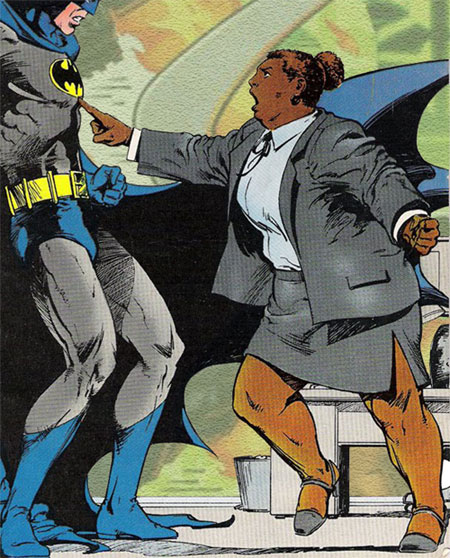
Here she is, telling Batman where he can stuff it. BATMAN. Even Superman is a little bit scared of Batman, but not Amanda Waller.

Read More »

pokémorality: black & white

Villains who actually kind of have a point are always more interesting than your garden-variety megalomaniac.
Villains who actually kind of have a point are nearly always more interesting than your garden-variety megalomaniac.

(This article was originally published on a now-defunct videogame analysis site, and has been backdated to reflect this. Also, spoilers for Pokémon Black and White)

When I was twelve years old, Red and Blue hit the playground and I spent hours of my young life shuffling through the tall grass, leaving piles of unconscious Pidgeys in my wake. Today, I do this in airports with a new generation of ubiquitous pest Pokémon whose names I cannot remember.

The real-life implications of my diligent training seem grim; I descend on an idyllic patch of grass full of local wildlife, and systematically beat, burn or electrocute them into submission. I will capture some of these Pokémon, but most will never get the privilege of training with me and massacring their wild counterparts for hours on end. Most of the little monsters end up rotting on my PC in suspended animation. But honestly, would it really be better to release them into the wild, so they can continue to be knocked unconscious on a daily basis by aspiring trainers?

This seems like a dire fate for any animal, but one of the crucial aspects of this universe is that Pokémon are not animals. They are considerably more sentient than animals, which implies they have agency. The franchise has used this to counter comparisons between Pokémon battles and, say, cock-fighting. Pokémon are our friends, we are reassured again and again. Pokémon have a choice and Pokémon like to fight! Battles are not an arena where dumb animals are enslaved and tormented into violence, but a beautiful collaboration between trainer and monster to achieve greatness as defined by the parameters of the fictional universe they inhabit.

The core tenet of any fictional universe is that the rules are different. Drawing real-world parallels is an interesting exercise, but usually a superfluous one when it comes to enjoying a game for what it is. If Professor Oak says Pokémon are my friends, it must be true. I did not at twelve years old (and still do not in my twenties) need any more justification to be able to enjoy Pokémon. I can buy into the straightforward premise of a happy world where cute monsters fight other cute monsters, no one really gets hurt and everyone is friends.

In light of this, it seems like a counter-intuitive choice to introduce a moral grey area in the obtusely-titled Black and White.

The bad guys in all previous Pokémon games followed the model of the anime; single-minded villains with hordes of dumb cronies and megalomaniac tendencies. The mission was innately satisfying in its simplicity: you must stop the bad people from taking Pokémon away from good people, because the good people are friends with Pokémon and the bad people are mean. In Pokémon Black and White, Team Plasma have more complex motives. Lord “N”, their mysterious young figurehead, is obsessed with the idea of separating Pokémon from humans permanently. The objective of Team Plasma throughout most of the game is to free all Pokémon from perceived slavery, to save them and to help them become “perfect.”

The most obvious layer of confusion is that Team Plasma are using Pokémon to battle as a means to this end. It must be obliquely assumed that there is literally no other way to incite conflict in the Pokémon universe, since we can hardly have poor Bulbasaur trying to deflect bullets with Vine Whip. At one point, after defeat, Lord N even acknowledges his hypocrisy: “Tsk! Why? Is it impossible for me to win while feeling bad about being a Trainer?”  However, most of his rhetoric is consistent: Pokémon must be liberated from the service of humans. The existence of this character challenges the ethics of the Pokémon world.

I talk to everyone I meet in the world of Pokémon. As a result, I am resigned to skimming through a significant amount of filler dialogue before I find that elusive TM or Rare Candy. Thus, I am in a position to assure you that the chat that you will experience in Black and White is nothing short of cloying. Every second person will tell you how much they love Pokémon, how much your Pokémon love you, how Pokémon and people need each other, to grow together in peace and harmony with all the Pokémon hugging and singing and dancing. This is the entirety of the argument that is supposed to motivate the player to battle fiercely and unequivocally for the propagation of the current world order. I am aware that these games are marketed at twelve year olds. I feel immovably certain that my twelve year old self, strategy guide clutched in sweaty palm, would have been mortally offended by the puerile drivel offered by these games as an argument for keeping Pokémon confined to their balls.

N has a valid point. In fact, he gives voice to the single most common criticism of the concept of Pokémon, one that has been levelled at the franchise since its inception. For the first time, these criticisms have not only been acknowledged by the games, but incorporated as a keystone of the narrative. This had the potential to take the Pokémon universe in an excitingly unprecedented direction. The problem is that the moral question is presented to the player at the outset, and then promptly drowned under a tirade of cheerily vague assertions of friendship and love. We are introduced to a grey area and then told to ignore it. N is revealed to be yet another megalomaniac with daddy issues and no one learns anything.

The potential for moral ambiguity in Black and White was so huge that it was disappointing to realise that this game was not going to act as a debate. Instead, the question is clumsily shoehorned into the existing Pokémon formula and then quickly dismissed before anyone can get too uncomfortable. The introduction of a Team fighting for the freedom of Pokémon could have been a genius stroke, but half-hearted execution has firmly relegated Plasma to the hall of entirely unmemorable Pokémon villains. As a member of the older generation of Pokémon fans – and one who snored her way through Diamond and Pearl – this wasted potential ultimately ruined the game for me. For a brief tantalising moment, I thought I was dealing with a darker story and a moral grey area. Instead, Black and White managed to firmly live up to its name.