read women 2014 + drunk book reviews

content note: large bottle of pinot grigio
content warning: large bottle of pinot grigio

“There are a lot of readers who pride themselves on not paying attention to the identities of their favorite writers. […] How many books by writers of color do you think you’ll find on their bookshelves? I’d lay odds that if there are any at all, they will be far outnumbered by the books by white authors. Not necessarily because those readers are deliberately choosing mostly white/male authors. They don’t have to. The status quo does it for them.”

Nalo Hopkins

#ReadWomen2014 is about challenging that status quo. At some point last year, I realised that despite the fact that I am a self-professed feminist nerd, my bookshelf is both on high on testosterone and blindingly white. I am not going to belch statistics about diversity in literature at you, because you can get them all here and that is not what this post is about. This post is about putting my money where my literary feminist mouth is. Spurred on by the launch of the Read Women campaign, I decided to do exactly that for 2014. Read women and only women for one full year.

Anyone who reads this blog or who has talked to me for more than five seconds knows how I feel about stories. I don’t think stories are simply a way of labeling and processing the world around us. I believe they shape the world around us, that they are the world both around us and within us. Narratives gain a foothold in our collective consciousness and gradually become a reality. Stories are how we explain ourselves to ourselves. And when it’s white men doing all the explaining, you end up with a story of a world where white men are the most important, the most influential, the most powerful, the most heroic, and anyone who is not white or male has trouble getting a word in edgeways.

I think studying English Literature (as I did) exacerbates the tendency to privilege the white male literary canon, especially if you are not (as I was not) a feminist. When you have five fat novels to read every week and you know there is a vanishingly small chance of getting through even half of them, you start prioritizing. And for some totally mysterious reason (*coughpatriarchy*), when it comes down to the wire, the indispensable texts, the keys to understanding the whole era/genre – and the ones that you absolutely must finish if you’re going to survive your next seminar or your end-of-term exams – those books always tend to be written by men. After four years, this hierarchy of importance and this vision of the canon became deeply ingrained in my ideas about what I should be reading.

I remember clearly the moment where I stopped thinking about what I should be reading, and started reading for pleasure again. It was August 2010, the summer after I graduated. I had been hawking around a cheap paperback copy of On The Road by Jack Keroauc, because what better book for a long lazy summer of freedom than a seminal travel novel from one of the greats of the Beat Generation? I’d had it in my rucksack for nearly three months, and it was dog-eared and stained, but I was still only around three-quarters of the way through. Every time I had an opportunity to sit down and read it, I would find something else to occupy my time. However, this day was a sunny day and I wandered out into the garden of my parents’ house with a blanket and a glass of cranberry juice and On The Road tucked under my arm, grimly determined to finish the damn thing.

Read More »

because history or something

He's probably pissed off because Ygritte is far too sassy for a lady living in Ye Olde Generic Medievale Tymes
The King of the Ice Zombies also has a lot of opinions about historical accuracy in fantasy.

OK, Internet. New Game of Thrones just started, and I know we’re all very excited.[1] Before the deluge of internet commentary really begins, I think this is an appropriate moment to have a chat about the relationship between fiction and history, and more specifically the relationship between the fantasy genre and the specific periods of Euro-centric history from which it tends to borrow heavily. And specifically, to answer the question: what do we mean by historical accuracy?

It’s a tale as old as the Internet. Someone writes an article about a book/film/game/ interpretative shadow-puppet musical from the fantasy genre. Some members of the audience say, “Hey, I really like this thing, but I would like it more if the women were not being sexually assaulted quite so constantly and the brown people were not costumed entirely in Generic Tribal Chic.” Then, without fail, a deeply indignant nerd type will pop his head over the parapet of the comment box and let forth his ancient war cry: “BUT HISTOOOOOOORY THEREFORE YOUR ARGUMENT IS INVAAAAAALID!!!”

It may seem like I’m overstating for effect here, but this exact exchange just happened on a recent post from Media Diversified. Shane Thomas made some excellent (and, at this stage, well-worn) points about Game of Thrones and its race problems. This attracted the attention of one intrepid commenter, who didn’t bother to read the whole post but nonetheless left a long comment – equal parts condescending and clueless – which boiled down to, “The Mongols existed at some point, therefore Game of Thrones can’t be racist.” In his response, Thomas acknowledges that he is aware that history is indeed a thing, but the fact that history is extremely racist does not give a modern TV show set in a fictional world a free pass to also be racist.

Read More »

frozen: a tale of two sisters

Frozen fan manip. source: could not find one apart from Pinterest, help me out if you know!
Frozen fan manip. source: I could not find out who made this. Let me know if you know

Redundant spoiler alert: ALL THE SPOILERS.

Prior to the release of Disney’s Frozen, I highlighted the fact that it was getting some pretty bad pre-release press from fellow feminist pop culture bloggers. The Feminist Fangirl wrote a post about how the original female-centric epic-quest fairytale appeared to have been gutted in favour of yet more bland princess fare. Then, the lead animator put his foot in it by making some poorly thought-out comments about how it’s really difficult to animate female characters, because they have to show emotion but they also have to be pretty, so sometimes they just end up all looking the same. Nightmare, am I right?

When Frozen was released, I deliberately resisted reading any reviews until I’d seen it for myself, although the general background buzz on the feminist blogosphere indicated that it was a lot better than expected. And having eventually seen it, I have to agree. Frozen is a feminist movie.

Read More »

adventures with genderists

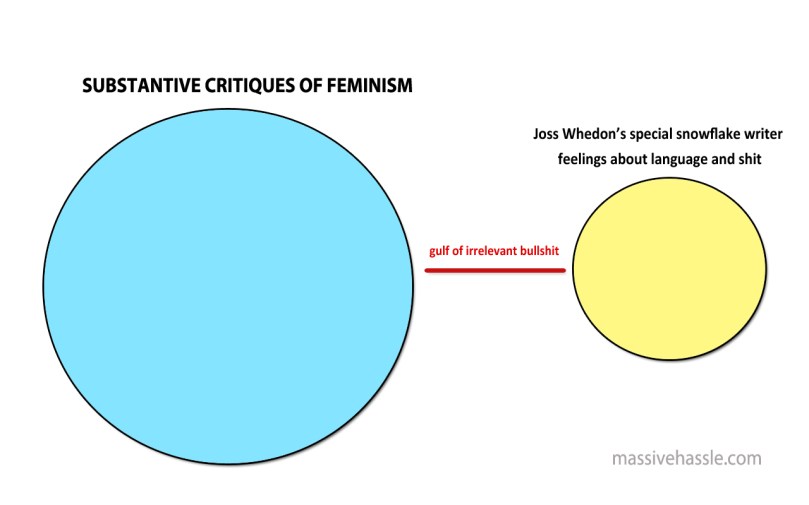
josswhedonJoss Whedon spoke about feminism at a benefit event for an organisation called Equality Now. More accurately, Joss Whedon spoke about the word “feminist”, because this incoherent self-satisfied trainwreck of a speech completely and utterly failed to engage with the substance of feminism for most of its fourteen minute duration.

Quite a few people sent me this video. Most of them were like, “Look! Yay! A famous nerdy dude said some stuff about feminism!” Sorry friends, but that literally could not have been further from my reaction. Jezebel called it perfect  (lol and also facepalm). Lots of feminist organisations I follow on Facebook posted it with approving commentary. (Including The Y Factor, who appear to have deleted it since I left a mild comment suggesting it was a crock of shit. Bad form, Y Factor. If you thought it was good, own it and explain why.)

It’s possible that I would have been more on board with Whedon’s speech if I could actually follow it. He starts off describing – in indulgent syllable-by-syllable detail – how “feminist” as a word just does not do it for him personally. Then he changes track and for a while seems to be equating the word “feminist” to the word “racist”, even though those words have nothing in common besides the dreaded “-ist” at the end. After that, he abandons “feminist” altogether and suggests that we need an equivalent word to “racist” for when we’re talking about gender discrimination. Those words already exist, I hear you cry? Sexist? Misogynist? Nah, those words don’t do it for Whedon either because some people are resistant to them, but mainly because he’s too busy trying to introduce his new word which he came up with ALL BY HIMSELF, GUYS. Guess what it is? Wait until you hear this genius stroke! Genderist! People who discriminate based on gender can be called “genderist”! Inspired! And this will achieve… what exactly? I have no clue, and neither does Whedon by the sounds of things, but he really wants everyone to start using it right away.

This post is long, so if you’d prefer, you can just look at the accompanying diagram, which is probably the most succinct transmission of my thoughts on any subject ever to date. But if you want more, there is more.

Read More »

girls don’t play real games

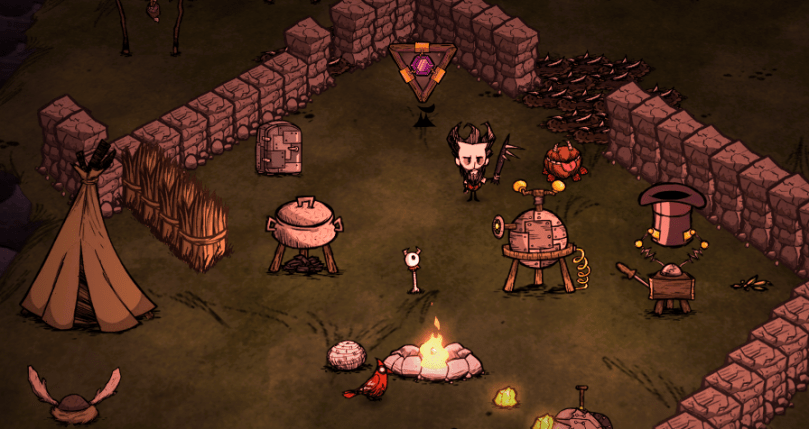
Thankfully the obscene number of hours I’ve racked up on Don’t Starve don’t count, because it’s not a real game
Thankfully the obscene number of hours I have racked up on Don’t Starve don’t count, because it’s not a real game

Three times in as many months, I have had some variation on the following conversation with three different dudes.

Me: Blah blah blah so misogyny in games is obviously a thing blah blah…
Dude: But girls don’t even play videogames!
Me: Actually, they do. Recent surveys show that around 45 per cent of gamers are women and this number grows every year. Also, overall, the number of female gamers is significantly higher than the number of teenage male gamers, who are commonly considered to be the primary target market for videogames.
Dude: … yeah, but girls don’t play real games.

You know, they only play Sims 3 or Angry Birds or whatever. They’re not serious gamers. Serious gamers play, you know, real games.

Inevitably, after a little bit of probing, the definition of “real games” turns out to be “Xbox first-person shooters.”

Read More »

an ode to sansa stark

“At least my hair still looks fab.”

Housekeeping: This post is based solely characterisations in the TV show. SPOILERS for Game of Thrones up to Season 3

I like Game of Thrones for many reasons, up to and including my pantsfeelings for Tyrion. But as the series has developed, one thing that has really stood out to me for all the right reasons is the characterisation and treatment of female characters. When feminists advocate for more strong female characters and better treatment of female characters, a lot of people seem to hear ALL FEMALE CHARACTERS MUST BE PERFECT and NO BAD THINGS MUST EVER HAPPEN TO FEMALE CHARACTERS, respectively. This is not what we are advocating for. We are advocating for female characters who are, respectively, well-rounded and flawed in interesting ways, and who are more than disposable props used to further the male protagonist’s emotional journey.

Game of Thrones is full of women; all of them are flawed, some of them are outright detestable and, as one would expect, they are in no way immune to having graphically violent things happen to them. Granted, those violent things are usually pertinently gendered (we did all just watch a lady get stabbed to death in her pregnant belly a few weeks ago) and deserving of their own discussion, but in terms of character creation, the series has so far done an excellent job of portraying the women of Westeros as complex and engaging. Read More »

world war disappointed

World War Z: An Oral History of the Zombie War is one of my favourite books ever. I have read it three times and it scared the crap out of me. Good job, World War Z. Unfortunately, Hollywood got its hands on it and stripped it of everything that made it unique and terrifying and profoundly human, because why have any of those things, when you can give Brad Pitt a gun and a vague UN job and throw him up against a big writhing pile of CGI zombies? Don’t worry though, we’re supposed to give a shit about his character because he has a Generic Family with two adorable little girls and he says things like “It’s going to be okay, honey!” and “Tell them I’m coming back!” a lot.

I am not exaggerating:

so the topic of why fast zombies are stupid – both in terms of plausibility and symbolic efficacy – has been well covered. No one puts it better than Simon Pegg:

I know it is absurd to debate the rules of a reality that does not exist, but this genuinely irks me. You cannot kill a vampire with an MDF stake; werewolves can’t fly; zombies do not run. […]The speedy zombie seems implausible to me, even within the fantastic realm it inhabits. A biological agent, I’ll buy. Some sort of super-virus? Sure, why not. But death? Death is a disability, not a superpower. It’s hard to run with a cold, let alone the most debilitating malady of them all.

More significantly, the fast zombie is bereft of poetic subtlety.[…] [T]he zombie trumps all by personifying our deepest fear: death. Zombies are our destiny writ large. Slow and steady in their approach, weak, clumsy, often absurd, the zombie relentlessly closes in, unstoppable, intractable.

However (and herein lies the sublime artfulness of the slow zombie), their ineptitude actually makes them avoidable, at least for a while. If you’re careful, if you keep your wits about you, you can stave them off, even outstrip them – much as we strive to outstrip death. Drink less, cut out red meat, exercise, practice safe sex; these are our shotguns, our cricket bats, our farmhouses, our shopping malls. However, none of these things fully insulates us from the creeping dread that something so witless, so elemental may yet catch us unawares – the drunk driver, the cancer sleeping in the double helix, the legless ghoul dragging itself through the darkness towards our ankles.

Don’t get me wrong, the idea of crazy rabid people who want to tear you apart and eat you is pretty horrifying, especially when the infection seems to disproportionately effect world-class sprinters. BUT, as Red Lemonade points out, they are not zombies. This is not what zombie means. I’m not saying fast zombies don’t work and should never exist. I believe they have their place in the monster canon. But the slow zombie – the inevitable shuffling mass of death – that zombie is KEY to World War Z.

According to visual effects supervisor John Nelson, the reasoning behind having zombies who look like super-speedy heroin addicts is to make them more predatory because “everyone has seen everything in this genre.” Yes. Yes they have. Including fast zombies. If originality was really a concern here, a good place to start would be NOT making YET ANOTHER MOVIE about Kickass Government Operative Guy Saving The World. The book is not compelling because it has super-special original zombies. It is compelling because it is structured as an oral history that takes on the concept of zombies on an unprecedented scale.

Read More »